
Should I use heat set inserts or self-tapping screws in 3D printed parts? Use self-tapping screws when the part is low-load, low-cost, and unlikely to be opened many times. Use heat set inserts when the joint needs repeated assembly, better thread durability, stronger screw retention, more stable preload, or a more serviceable fastening structure.
Both fastening methods can work in 3D printed parts. The better choice depends on the part’s load, material, boss design, number of assembly cycles, screw size, and whether the joint needs to survive service, vibration, or repeated screw removal.
A self-tapping screw is not automatically wrong. A heat set insert is not automatically necessary. The right choice is the one that matches the actual engineering requirement.
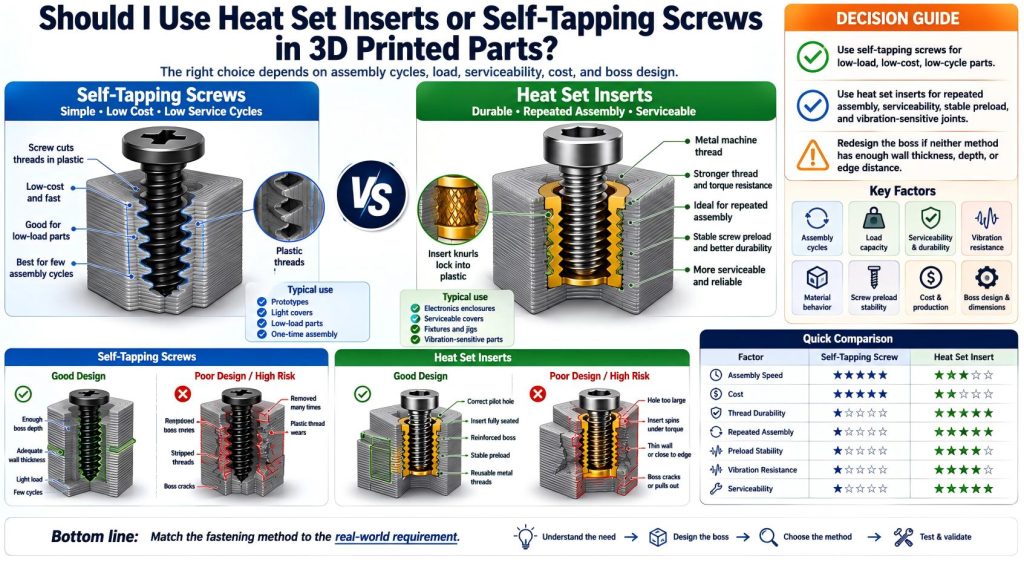
Short Answer
Choose self-tapping screws for simple, low-load, low-cycle parts. Choose heat set inserts for durable, serviceable, repeated assembly joints.
| Fastening Method | Best For | Main Risk |
|---|---|---|
| Self-tapping screw | Low-cost prototypes, light covers, one-time assembly, low service cycles | Plastic thread wear, loosening after repeated removal, boss cracking if overtightened |
| Heat set insert | Repeated assembly, serviceable covers, brackets, fixtures, vibration-sensitive joints | Needs correct pilot hole, boss support, installation heat, and insert seating depth |
How Self-Tapping Screws Work in 3D Printed Parts
A self-tapping screw forms or cuts its own thread into the printed plastic. This makes it simple, low-cost, and fast to assemble. It does not require brass inserts, soldering iron installation, or a separate insert purchase.
Self-tapping screws are useful when the part does not need frequent service and the joint only needs modest holding force.
They are often used for:
- quick prototypes
- light covers
- temporary fixtures
- low-cost enclosures
- small cosmetic panels
- one-time assembly parts
- low-load brackets
- non-critical internal parts
The main weakness is that the plastic thread is the thread. If the screw is removed and reinstalled many times, the plastic can wear, strip, crack, or lose clamping force.
How Heat Set Inserts Work in 3D Printed Parts
A heat set insert creates a metal machine thread inside the printed part. The insert is heated and pressed into a pilot hole. The surrounding plastic softens, flows around the insert knurls, and locks the insert into the boss after cooling.
The screw then threads into metal instead of directly into plastic. This makes heat set inserts useful when the assembly must be opened and closed repeatedly, or when screw preload needs to be more stable over time.
Heat set inserts are often used for:
- serviceable electronics enclosures
- robot panels and removable covers
- fixtures and jigs
- motor brackets
- sensor mounts
- battery covers
- repeated assembly parts
- functional prototypes that need durability
- machine accessories
- small-batch manufacturing parts
For general insert selection, see How to Choose Heat Set Inserts for 3D Printed Parts.
When Self-Tapping Screws Are the Better Choice
Self-tapping screws can be the better choice when simplicity matters more than long-term serviceability. They are especially useful when the part is temporary, low-cost, lightly loaded, or unlikely to be opened many times.
Self-tapping screws may be better when:
- the part is a quick prototype
- the joint will only be assembled once or twice
- the load is light
- the screw does not need high preload
- the part does not see vibration
- the boss has enough plastic for thread engagement
- cost and speed matter more than repairability
- the design may change soon
For early prototypes, self-tapping screws can be a perfectly practical choice. They are the pocketknife of printed fastening: not elegant for every job, but useful when the situation is simple.
When Heat Set Inserts Are the Better Choice
Heat set inserts are usually better when the joint must survive repeated screw removal, service cycles, vibration, or higher clamp force. They also help when the printed part is part of a reusable product, fixture, or mechanical assembly.
Heat set inserts may be better when:
- the screw will be removed and reinstalled many times
- the part needs serviceable access
- the joint needs stable preload
- the part may see vibration or repeated handling
- the assembly uses machine screws
- the boss can support the insert geometry
- the joint needs better torque resistance
- the part is a fixture, bracket, panel, enclosure, or machine component
For repeated assembly behavior, see Heat Set Inserts for Repeated Assembly in 3D Printed Parts.
Comparison Table
| Design Factor | Self-Tapping Screw | Heat Set Insert |
|---|---|---|
| Assembly speed | Fast | Slower because insert installation is required |
| Cost | Lower | Higher due to insert hardware and installation time |
| Thread durability | Plastic thread wears over time | Metal thread is more durable |
| Repeated service | Limited | Better |
| Screw preload stability | Lower, depends on plastic thread condition | Better, but still depends on boss and material |
| Installation complexity | Simple | Requires heat and controlled seating |
| Repairability | Plastic threads can strip | More serviceable if installed correctly |
| Best use | Low-load, low-cycle fastening | Functional, serviceable, repeated assembly fastening |
Assembly Cycles Are Often the Deciding Factor
The number of times the screw will be removed is one of the clearest decision factors.
If the screw will be installed once and rarely touched again, self-tapping screws may be enough. If the screw will be removed for maintenance, calibration, battery access, electronics service, fixture changes, or product repair, heat set inserts usually become more valuable.
Repeated screw removal can damage plastic threads. The first assembly may feel fine, but the third, fifth, or tenth assembly may loosen, strip, or lose preload.
For repeated assembly failure behavior, see Heat Set Insert Failure Modes in Repeated Assembly Structures and Why Does Repeated Assembly Weaken Heat Set Inserts?.
Boss Design Still Matters for Both Options
Both self-tapping screws and heat set inserts need a good boss. The boss is the printed structure around the fastener. If the boss is too thin, too close to an edge, or poorly connected to the part body, either fastening method can fail.
For self-tapping screws, the boss must support thread formation and resist splitting. For heat set inserts, the boss must support installation heat, insert expansion, screw torque, and pull-out load.
A good boss should provide:
- enough outside diameter
- enough wall thickness
- enough screw or insert depth
- enough edge distance
- fillets where the boss meets the base
- support ribs when the boss is tall
- print orientation that resists splitting
- a load path into the main part body
For boss geometry, see How to Design Bosses for Heat Set Inserts, Heat Set Insert Minimum Wall Thickness Reference for 3D Printed Parts, and Heat Set Insert Edge Distance Reference for 3D Printed Parts.
Material Choice Changes the Decision
Material behavior affects both fastening methods. PLA, PETG, ABS, ASA, nylon, and fiber-filled materials all respond differently to screw pressure, plastic deformation, heat set installation, and repeated assembly.
| Material | Self-Tapping Screw Behavior | Heat Set Insert Behavior |
|---|---|---|
| PLA | Can form threads, but may crack if overtightened | Good stiffness, but boss cracking risk if hole is too small or overheated |
| PETG | Tougher, but threads may relax under preload | Good toughness, but preload loss and creep should be checked |
| ABS / ASA | Functional if printed with good layer adhesion | Often suitable for serviceable parts with controlled installation |
| Nylon | Can deform or relax under screw load | Tough, but preload retention and creep need testing |
| Fiber-filled materials | Stiffer, but can be brittle around thread features | Good stiffness if boss geometry avoids stress concentration |
For material comparison, see PLA vs PETG vs ABS for Threaded Inserts and Layer Adhesion and Heat Set Insert Strength in 3D Printed Parts.
Screw Preload and Loosening
Self-tapping screws rely on plastic threads to hold preload. If the plastic creeps, wears, or strips, the screw can lose clamp force. Heat set inserts provide metal threads, but the surrounding plastic boss can still relax or deform under sustained load.
This means heat set inserts are usually better for preload stability, but they are not magic little brass anchors floating outside physics. The boss, material, screw length, and tightening torque still control the joint.
For preload behavior, see Why Does Screw Preload Drop in 3D Printed Insert Joints? and Heat Set Insert Torque Range Reference for 3D Printed Parts.
When Self-Tapping Screws Fail
Self-tapping screws usually fail when the plastic thread can no longer hold the screw. This may happen after overtightening, repeated removal, insufficient boss size, poor material choice, or vibration.
Common self-tapping screw failure modes include:
- plastic threads strip
- boss splits during screw installation
- screw loosens after repeated service
- screw preload drops over time
- thread engagement is too short
- thin boss wall cracks
- material creeps under clamp force
- hole becomes enlarged after repeated use
These failure modes are why self-tapping screws are better for low-cycle fastening than repeated service structures.
When Heat Set Inserts Fail
Heat set inserts usually fail when the insert is installed into poor printed geometry or used beyond what the boss can support. The metal thread may remain intact while the printed boss becomes the failure point.
Common heat set insert failure modes include:
- insert spins during tightening
- insert pulls out under load
- boss cracks during installation
- hole is too large or too small
- insert sits too proud or too deep
- screw bottoms out before clamping
- boss wall is too thin
- layer adhesion is weak
- preload drops in creep-prone materials
For related failure explanations, see Why Do Heat Set Inserts Spin in 3D Printed Parts?, Why Do Bosses Crack Around Heat Set Inserts?, and Why Do Heat Set Inserts Fail When the Hole Is Too Large?.
Cost and Production Considerations
Self-tapping screws are faster and cheaper for simple parts. Heat set inserts add hardware cost and installation time, but they can reduce thread damage, service problems, and long-term assembly failures.
For a one-off prototype, self-tapping screws may be more efficient. For a product, fixture, or part that may be opened by users, heat set inserts often provide a better long-term structure.
| Project Type | Better Default Choice | Reason |
|---|---|---|
| Quick prototype | Self-tapping screws | Fast, cheap, easy to change |
| Temporary test part | Self-tapping screws | Low cost and low service expectation |
| Electronics enclosure opened often | Heat set inserts | Repeated screw removal needs durable threads |
| Fixture or jig | Heat set inserts | Service cycles and stable preload matter |
| Vibration-sensitive bracket | Heat set inserts | More controlled thread and preload behavior |
| Small cosmetic cover | Depends | Use self-tapping if rarely opened, inserts if serviceable |
Practical Decision Rule
Use this simple rule:
- Use self-tapping screws when the part is simple, low-load, low-cost, and rarely opened.
- Use heat set inserts when the part needs repeated assembly, serviceability, stable preload, or better thread durability.
- Redesign the boss if neither option has enough wall thickness, depth, or edge distance.
- Test the actual material and screw size before relying on either method for functional parts.
If the screw is only visiting once, self-tapping may be enough. If the screw needs to move in and out like a regular tenant, give it a metal thread to live in.
Related Engineering Guides
- How to Choose Heat Set Inserts for 3D Printed Parts
- Heat Set Insert Hole Size Guide
- How to Design Bosses for Heat Set Inserts
- Pull-Out Strength of Heat Set Inserts in 3D Printed Parts
- Torque Resistance of Heat Set Inserts in 3D Printed Parts
- Screw Engagement Length for Heat Set Inserts in 3D Printed Parts
Related Repeated Assembly References
- Heat Set Inserts for Repeated Assembly in 3D Printed Parts
- Heat Set Insert Failure Modes in Repeated Assembly Structures
- Recommended Fastening Structure for Repeated Assembly PETG Parts
Related Failure Questions
If the joint already depends on extra retention, review whether adhesive or glue is masking a hole size or boss support problem.
- Why Do Threads Become Loose in Heat Set Inserts?
- Why Does Repeated Assembly Weaken Heat Set Inserts?
- Why Do Threaded Inserts Loosen After Repeated Screw Removal?
- Why Does Screw Preload Drop in 3D Printed Insert Joints?
- Why Do Heat Set Inserts Fail Under Vibration?
Related Applications
- Heat Set Inserts for Electronics Enclosure Lid Cycling
- Heat Set Inserts for Robot Joint Service Panels
- Heat Set Inserts for Printed Jigs with Replaceable Wear Plates
- Heat Set Inserts in Electronics Mounting Systems
FAQ
Are heat set inserts better than self-tapping screws?
Heat set inserts are better for repeated assembly, serviceable parts, stronger threads, and stable screw preload. Self-tapping screws are better for simple, low-cost, low-load parts that will not be opened often.
Can I use self-tapping screws directly in 3D printed plastic?
Yes. Self-tapping screws can work in 3D printed plastic when the boss is large enough, the load is low, and the screw will not be removed many times. The plastic thread may wear if the screw is repeatedly removed.
When should I switch from self-tapping screws to heat set inserts?
Switch to heat set inserts when the part needs repeated service, stronger thread durability, better preload retention, vibration resistance, or a more professional reusable assembly.
Do heat set inserts always make a 3D printed part stronger?
No. Heat set inserts improve the thread interface, but the printed boss still controls the real strength. Poor hole size, weak boss design, thin walls, and bad installation can still cause failure.
Which is better for electronics enclosures?
Use self-tapping screws for simple low-cost enclosures that are rarely opened. Use heat set inserts for enclosures that need repeated access, battery replacement, electronics service, or reliable screw preload.