
Should I use heat set inserts for parts that need frequent disassembly? Yes, heat set inserts are usually a better choice than direct plastic threads or self-tapping screws when a 3D printed part needs to be opened, serviced, adjusted, or reassembled many times. They provide reusable metal threads and reduce thread wear in the printed plastic.
However, heat set inserts do not make a joint infinitely reusable. Frequent disassembly still depends on boss design, screw engagement, seating depth, material behavior, screw torque, preload control, and whether the screw bottoms out before clamping the assembly.
For serviceable 3D printed parts, the insert is only one part of the fastening structure. The whole joint must be designed for repeated use.
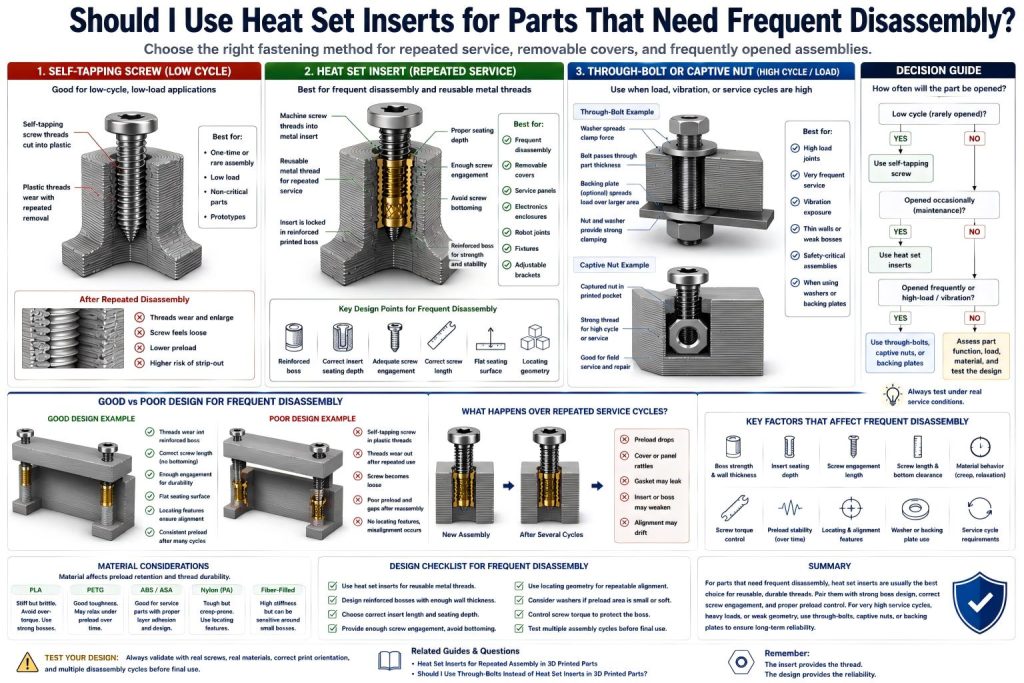
Short Answer
Use heat set inserts when a part needs repeated screw removal and reinstallation. Do not rely on direct plastic threads for frequent disassembly unless the load is low and the service cycles are limited.
| Disassembly Situation | Recommended Fastening Choice | Main Design Concern |
|---|---|---|
| One-time or rare assembly | Self-tapping screw or plastic thread may be enough | Low cost and simple assembly |
| Occasional maintenance | Heat set inserts are usually recommended | Thread durability and screw preload |
| Frequent service access | Heat set inserts with good boss design | Repeated torque, seating depth, preload loss |
| High-cycle removable panel | Heat set inserts plus washer, locating geometry, or metal support | Clamp stability and alignment |
| Structural or high-load service joint | Consider through-bolts, backing plates, or hybrid fastening | Load transfer and testing |
Why Frequent Disassembly Changes the Fastening Choice
A screw installed directly into 3D printed plastic may work well the first time. The problem appears after repeated removal and reinstallation. Each cycle can wear the plastic thread, enlarge the hole, reduce clamp force, or make the screw feel loose.
Frequent disassembly can create:
- plastic thread wear
- loose screw fit
- reduced screw preload
- boss cracking from repeated torque
- hole enlargement
- poor alignment after reassembly
- screw bottoming before clamp force
- damaged covers, panels, or brackets
Heat set inserts help by moving the screw thread interface from plastic to metal. This is why they are commonly used in serviceable printed parts.
For a broader repeated assembly reference, see Heat Set Inserts for Repeated Assembly in 3D Printed Parts.
When Heat Set Inserts Are the Right Choice
Heat set inserts are usually the right choice when a printed part will be opened or adjusted repeatedly and the boss can support the insert geometry.
They are often appropriate for:
- electronics enclosure lids
- battery access covers
- robot service panels
- sensor adjustment brackets
- replaceable fixture plates
- maintenance covers
- inspection panels
- calibration fixtures
- modular robotics parts
- small-batch functional products
For related applications, see Heat Set Inserts for Electronics Enclosure Lid Cycling and Heat Set Inserts for Robot Joint Service Panels.
When Heat Set Inserts May Not Be Enough
Heat set inserts are useful for repeated service, but they still rely on the printed boss. If the boss is thin, poorly supported, close to an edge, or made from a creep-prone material, repeated disassembly can still weaken the joint.
Heat set inserts may not be enough when:
- the part is load-bearing
- the joint sees vibration
- the boss is thin or unsupported
- the insert is near an edge or corner
- the screw requires high preload
- the part is opened very frequently
- the insert hole is oversized
- the screw bottoms out before clamping
- the material relaxes under preload
- failure would damage equipment or create risk
For high-load service joints, see Should I Use Heat Set Inserts in Load-Bearing 3D Printed Parts? and Should I Use Through-Bolts Instead of Heat Set Inserts in 3D Printed Parts?.
Heat Set Inserts vs Self-Tapping Screws for Frequent Disassembly
Self-tapping screws can be useful for quick prototypes, low-cost parts, and assemblies that are rarely opened. They become less reliable when the same screw is removed many times.
Heat set inserts are usually better for frequent disassembly because the screw engages a metal thread instead of cutting or wearing a plastic thread.
| Design Factor | Self-Tapping Screw | Heat Set Insert |
|---|---|---|
| First assembly speed | Fast | Slower because insert installation is required |
| Hardware cost | Lower | Higher |
| Thread durability | Plastic thread wears with repeated service | Metal thread is more durable |
| Frequent disassembly | Limited | Better |
| Preload repeatability | Lower after many cycles | Better if boss remains stable |
| Best use | Low-cycle parts | Serviceable repeated-use parts |
For the broader comparison, see Should I Use Heat Set Inserts or Self-Tapping Screws in 3D Printed Parts?.
Boss Design for Frequent Disassembly
The boss must survive not only the first installation, but also repeated screw tightening and loosening. A weak boss may crack, creep, or lose preload over time even if the metal insert remains intact.
A good serviceable boss should provide:
- enough boss outside diameter
- enough wall thickness around the insert
- proper insert seating depth
- enough screw engagement
- fillets at the boss base
- support ribs when the boss is tall
- enough edge distance
- a flat mating surface
- a load path into the main part body
- print orientation that resists splitting
For boss geometry, see How to Design Bosses for Heat Set Inserts, Boss OD Ratio for Heat Set Inserts in 3D Printed Parts, and Heat Set Insert Minimum Wall Thickness Reference for 3D Printed Parts.
Screw Engagement Matters More Over Time
In frequent disassembly, screw engagement must be long enough to hold the joint reliably, but not so long that the screw bottoms out inside the insert or boss.
A screw can feel tight for the wrong reason. If the screw bottoms out, it may stop turning before the cover, bracket, or panel is actually clamped. After repeated service, this can create loose joints, rattling panels, or poor preload.
Check:
- mating part thickness
- washer thickness if used
- insert seating depth
- available internal thread length
- screw length
- bottom clearance
- final clamp force
For screw engagement behavior, see Screw Engagement Length for Heat Set Inserts in 3D Printed Parts and Heat Set Insert Assembly Stack-Up Reference for 3D Printed Parts.
Seating Depth and Flushness
For parts that are opened often, insert seating depth should be controlled carefully. If the insert sits proud, the mating part may not sit flat. If the insert sits too deep, screw engagement and clamp behavior may change.
This matters in:
- electronics lids
- service panels
- thin covers
- gasketed covers
- removable fixture plates
- robot access panels
For flushness and seating decisions, see Should Heat Set Inserts Sit Flush or Below the Surface? and Heat Set Insert Seating Depth Reference for 3D Printed Parts.
Material Choice and Repeated Service
Material behavior matters because repeated disassembly changes both thread wear and preload behavior. Some materials crack easily. Others creep under screw clamp load. Some tolerate heat set installation well but relax over time.
| Material | Frequent Disassembly Behavior | Design Note |
|---|---|---|
| PLA | Stiff, but can crack around bosses if overtightened | Use controlled torque and avoid thin bosses. |
| PETG | Tough, but may relax under repeated preload | Check preload loss and cover looseness over time. |
| ABS / ASA | Useful for serviceable parts if layer adhesion is good | Control installation heat and boss geometry. |
| Nylon | Tough, but may creep under clamp load | Use locating geometry and avoid relying only on screw preload. |
| Fiber-filled materials | Stiff, but can be sensitive around small bosses | Use fillets, ribs, and test pilot holes. |
For material behavior, see PLA vs PETG vs ABS for Threaded Inserts and Layer Adhesion and Heat Set Insert Strength in 3D Printed Parts.
Preload Loss After Repeated Assembly
Repeated disassembly can reduce joint confidence even when the insert does not visibly fail. The screw may tighten differently each time. The mating surface may compress. The printed boss may relax. The cover may stop seating the same way.
Preload loss can show up as:
- loose panels
- rattling covers
- gasket leaks
- switch or sensor alignment drift
- screw loosening after vibration
- insert spin during tightening
- panel gaps after reassembly
For preload behavior, see Why Does Screw Preload Drop in 3D Printed Insert Joints?.
Frequent Disassembly May Need Locating Geometry
If a part is removed often, the screw should not be the only feature controlling position. Locating geometry helps the part return to the same place after each service cycle.
Useful locating features include:
- shoulders
- pockets
- tabs
- alignment ribs
- dowel pins
- cover lips
- flat seating surfaces
- mechanical stops
The insert should provide thread durability. The geometry should provide alignment. This matters for sensor mounts, switch brackets, covers, and fixtures where position must repeat.
When to Consider Captive Nuts or Through-Bolts
If a part is opened very frequently or carries meaningful load, heat set inserts may not be the only option. Captive nuts, through-bolts, washers, or metal backing plates may be better when the boss is weak or the screw load is high.
Consider alternatives when:
- the part sees high service cycles
- the boss is too thin for an insert
- the insert would be near an edge
- the part is load-bearing
- the assembly sees vibration
- the screw needs high preload
- the joint must be repaired in the field
- the part must survive many maintenance cycles
For through-bolt decisions, see Should I Use Through-Bolts Instead of Heat Set Inserts in 3D Printed Parts?.
Common Mistakes
- using self-tapping screws for parts that will be opened often
- installing inserts in weak bosses
- ignoring screw bottoming
- using screws that are too short for reliable engagement
- overtightening screws during every service cycle
- placing inserts too close to edges or corners
- assuming metal threads prevent all preload loss
- not using locating geometry for repeatable alignment
- not testing after multiple assembly cycles
- using inserts where through-bolts or captured nuts would be safer
For related failure behavior, see Why Does Repeated Assembly Weaken Heat Set Inserts?, Why Do Threaded Inserts Loosen After Repeated Screw Removal?, and Why Do Threads Become Loose in Heat Set Inserts?.
Practical Decision Rule
Use this simple rule:
- Use heat set inserts when the part will be opened repeatedly and the boss can support the insert.
- Use self-tapping screws only when service cycles are low and loads are light.
- Add locating geometry when alignment must repeat after reassembly.
- Use washers, captive nuts, or through-bolts when service cycles, load, or vibration exceed what the printed boss can handle.
- Test multiple assembly cycles before trusting the design.
If a screw will visit the same hole many times, give it a metal doorway. But make sure the doorway is built into a wall that can survive the traffic.
Related Engineering Guides
- How to Choose Heat Set Inserts for 3D Printed Parts
- Screw Engagement Length for Heat Set Inserts in 3D Printed Parts
- How to Design Bosses for Heat Set Inserts
- Torque Resistance of Heat Set Inserts in 3D Printed Parts
- PLA vs PETG vs ABS for Threaded Inserts
- Layer Adhesion and Heat Set Insert Strength in 3D Printed Parts
Related Selection Questions
- Should I Use Heat Set Inserts or Self-Tapping Screws in 3D Printed Parts?
- Can Heat Set Inserts Be Removed and Reinstalled in 3D Printed Parts?
- Should I Use Through-Bolts Instead of Heat Set Inserts in 3D Printed Parts?
Related Repeated Assembly References
- Heat Set Inserts for Repeated Assembly in 3D Printed Parts
- Heat Set Insert Failure Modes in Repeated Assembly Structures
- Recommended Fastening Structure for Repeated Assembly PETG Parts
Related Applications
- Heat Set Inserts for Electronics Enclosure Lid Cycling
- Heat Set Inserts for Battery Pack Service Covers
- Heat Set Inserts for Robot Joint Service Panels
- Heat Set Inserts for Printed Jigs with Replaceable Wear Plates
FAQ
Are heat set inserts good for frequent disassembly?
Yes. Heat set inserts are usually a good choice for frequent disassembly because they provide reusable metal threads and reduce wear compared with screws driven directly into plastic.
Can heat set inserts become loose after repeated screw removal?
Yes. The metal thread may remain intact, but the printed boss can still weaken, creep, crack, or lose preload over repeated service cycles if the geometry or material is not suitable.
Are self-tapping screws okay for parts that are opened often?
Usually not. Self-tapping screws can work for low-cycle parts, but frequent removal can wear or strip the plastic threads. Heat set inserts are usually better for repeated service.
What else matters besides using heat set inserts?
Boss design, wall thickness, insert seating depth, screw engagement, screw length, torque control, material behavior, and locating geometry all affect repeated disassembly reliability.
When should I use through-bolts instead?
Use through-bolts, washers, captured nuts, or backing plates when the joint is load-bearing, vibration-sensitive, frequently serviced, or when the printed boss cannot safely support a heat set insert.